












The Bisang family from Münchenstein, Basel-Landschaft, is now in its fourth generation of running “London Tea.” They offer 360 varieties!
LONDON CALLING. The “London Tea” tea factory in Münchenstein—the largest and oldest in Switzerland—is easy to find. In front of the unassuming building in a residential neighborhood of this Basel suburb stand a British phone booth and a bright red double-decker bus from London. “The phone booth was a gift from a London tea broker to my father, as a thank-you for our long-standing business relationship. The bus is on loan from a Basel garage owner. It had been left to rust away in a backyard. Now it’s an eye-catcher in our front yard,” says Matthias Bisang. Together with his wife Viviane and his two sons, Noël and Fabrice, he runs the exclusive tea company “London Tea,” whose logo features the English lion and the unicorn from the royal coat of arms. Top photo, from left: Matthias Bisang with his sons Fabrice and Noël, and his wife Viviane Bisang.

The store is located on the famous Spalenberg, in the heart of Basel's Old Town.

The tea factory, on the other hand, is located in Münchenstein, BL.
THE TRADITION LIVES ON. The trading firm was founded in London in 1896 by two Swiss and five Englishmen—at a time when Queen Victoria ruled the global empire. Shortly thereafter, the “London Tea Company” opened branches in Munich, St. Louis (in Alsace), and Basel. At the time, the company dealt exclusively in just 12 black teas from China and India. Thanks to the efforts of the Bisang family, “London Tea” still exists today (as a manufacturer and a store on Basel’s Spalenberg) and celebrated its 125th anniversary in August 2021. Due to the pandemic, there was no grand celebration, but the company did introduce new blends with historic names such as Oxford, Westminster, Buckingham, Royal Ascot Tea, and Jewel of Earl Grey. With these additions, the assortment now comprises an incredible 360 varieties, including single-origin teas from around the world as well as blends. These blends are all produced in-house in Münchenstein, in historic-looking, massive stainless-steel blending kettles.
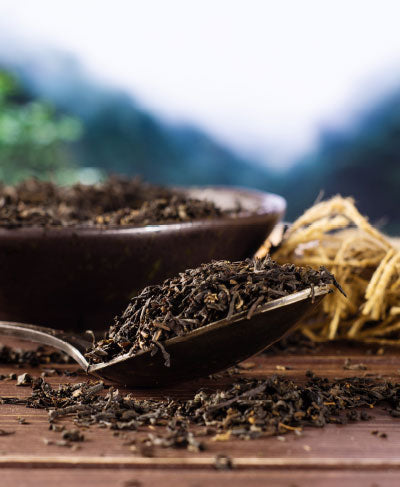
ALL HANDMADE. The factory truly lives up to its name—a great deal of manual labor is required here. Sixteen long-time employees at the factory carry out this work. Even with machine assistance, filling the tea bags requires skilled hands and care. “Tea is very sensitive to light, heat, and odors; it must be blended and packaged quickly and carefully to prevent any loss of quality,” explains Matthias Bisang. Physical strength is also required, as the valuable raw materials from all over the world arrive daily at the loading dock in large packages and containers labeled with their places of origin—names that delight tea lovers: Darjeeling, Ceylon, Assam, Japan, China. Bisang estimates that around 30 metric tons of herbs and teas arrive at the facility each year. The warehouse—essentially a treasure trove—is located in the basement, where a consistently cool temperature and darkness prevail. Here, in large, airtight barrels, herbs from the Alps, spices, and dried fruits for the house blends, all the rarities from overseas, which are specially marked with a silver crown sticker on the lime-yellow and royal-blue “London Tea” bags.

Tasting tea is a fine art. Striking the right balance requires a delicate touch.

Noël Bisang is responsible for production management and assists with testing and purchasing.

For teas from overseas, the steeping time is four minutes.
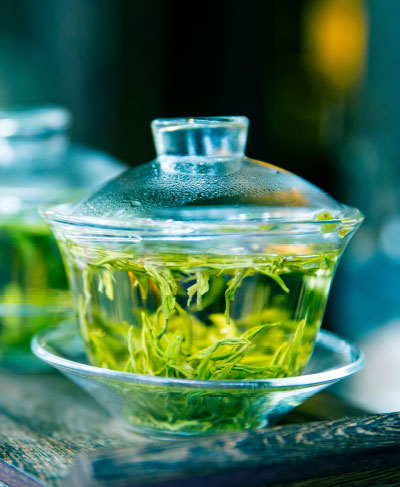
A GOOD NOSE IS ESSENTIAL. The Bisangs source their teas from overseas through so-called tea brokers in Hamburg. These brokers have access to the finest raw materials required for the “London Tea” quality label. Manufacturers send several samples from each harvest to Hamburg and Münchenstein, where they are then tasted. For these tastings, a fixed amount of 2.34 grams of tea is always used, and the steeping time is four minutes. First, Matthias Bisang—who, after completing a business apprenticeship, underwent advanced training in tea blending in Hamburg and trained as a tea tester under Master Warren Ford in London—visually inspects the raw material. With the eye of a connoisseur, he examines the dry and wet leaves, then the color in the white porcelain cup; only at the very end does he assess the sample with his nose and palate. A small sip of tea is taken from the cup with a spoon. If there are many samples to test, the tasters spit out the liquid, just as they do during wine tastings—even though there’s no risk of intoxication with tea. His sons, Noël and Fabrice, are often present during the tastings; as trained chefs, they also bring the necessary sensory expertise to the table.
THE GREEN MIRACLE POWDER. In addition to its own brand, Bisangs also sells matcha tea from Aiya, the leading manufacturer in Japan. Matcha, green tea ground into a powder, has evolved from a niche product to a superfood and the darling of food bloggers and magazines thanks to its healthy nutrients and vibrant color—it’s a real eye-catcher as an ingredient in dishes, smoothies, and shakes. “Young, health-conscious people in particular are looking for alternatives to coffee and have switched to matcha or herbal tea. We’re benefiting from this trend,” says Bisang, pointing to the large selection from Japan in the store at the Manufaktur. “Even the very expensive matchas—a pinch of which costs as much as caviar—are selling well here,” Bisang says proudly. There are plenty of purists who can afford these “champagne teas,” along with the accessories for the elaborate ceremony used to prepare authentic matcha. Since “London Tea” has about eighty percent private customers and a great online store, the pandemic didn’t exactly leave the business unscathed, but it had a relatively mild impact on operations. “We offer free shipping on orders of thirty francs or more—we do take a loss on that, but maybe online customers will be convinced by our quality and order again, perhaps even a little more,” says Bisang, explaining his strategy.


The specialty tea shop on Spalenberg in Basel offers a huge selection of teas.
THE CRUX OF ORGANIC TEA. In the factory store and the shop on Spalenberg, the large decorative tin cans are certainly on display, but only pre-packaged teas are sold. Small tins are available for scent samples. “Selling loose tea or allowing customers to smell the tea from the large tin cans is a no-go for us as a quality provider,” says Bisang. Cellophane packaging—which allows you to see the tea but also exposes it to light—is also frowned upon at “London Tea.” Packaging does present a dilemma: they want it to be as eco-friendly as possible, but also as secure as necessary. The bags from Münchenstein are made of paper with an aluminum coating on the inside to act as an odor barrier. For the individual pyramid tea bags, non-GMO sugarcane is now used instead of nylon, and these bags are 100 percent biodegradable. And how organic are the teas? “In countries of origin like India or China, the organic label is a tricky issue. The labels are inconsistent and don’t inspire much confidence,” explains Bisang. All teas bearing the “London Tea” label are rigorously tested for residues in a Hamburg laboratory by the distributor and, if everything is in order, certified. The Swiss herbs come exclusively from organic farms.
TAP WATER OR MINERAL WATER? Is it actually better to brew such fine tea with mineral water instead of tap water, given that tap water in many places is very hard? “Not necessary,” says Bisang. The calcium actually does strong teas like Assam good. And do the Bisangs themselves travel to the growing regions of their delicacies? “Yes, but purely for personal reasons. After all, we don’t buy ‘wild teas’ directly from producers. Our last trip four years ago took us to the highlands of Sri Lanka—it was absolutely beautiful.” We’ve been planning a trip to Japan for a long time, where we’d like to visit the Aiya production facility. Maybe it’ll finally work out this year,” Bisang hopes. Last question: Is there a coffee machine in the office and break room at “London Tea” in Münchenstein? “Of course! An excellent espresso can also be a delicacy and, along with milk or water, is very helpful in neutralizing the taste buds during tea testing,” Bisang explains.


