














1. COUNTRY OF ORIGIN: JAPAN
Even though the idea of grinding tea and then drinking it was first developed in China, authentic matcha comes from Japan. Over the centuries, processing methods have been refined, and in the 16th century, shaded cultivation was introduced. This is what makes Japanese matcha so unique and gives it its distinctive umami flavor.

2. THE COLOR
Each grade has its own color. Shaded cultivation means that only 10 percent of the sunlight reaches the leaves. This results in higher concentrations of chlorophyll and amino acids in the leaves. This gives the leaves an intense green color. When the leaves are ground into matcha, this coloration appears as a bright, rich green hue. The higher the quality, the more vibrant the green. Poor-quality matcha—or even “fake matcha”—can be identified by its yellowish or even brownish color.
3. THE AROMA
The flavor is largely determined by the shading process. The longer the tea plants are shaded, the more amino acids are produced. These give the tea a sweet and mellow flavor, which becomes more intense as the shading period increases. The crowning touch is the umami flavor for which Japanese matcha is known and the nutty aroma that is a hallmark of Japanese tencha production.

4. THE SHADOW
Authentic Japanese matcha is characterized by the fact that the plants are shaded for up to four weeks before harvest. This shading method ensures that only 10 percent of sunlight reaches the leaves. As a result, the leaves accumulate higher levels of chlorophyll and amino acids. Shading ensures that authentic matcha is not bitter. The reason for this is that the formation of bitter compounds—which accumulate in the leaves as a defense against sunlight—is significantly inhibited.
5. TENCHA PRODUCTION
Matcha isn’t just ground green tea. In addition to shading, the key difference from conventional green teas lies primarily in the processing into tencha. The purpose of green tea is to process the leaves in such a way that the nutrients are easily soluble in water, resulting in a delicious infusion. Tencha, on the other hand, is processed as gently as possible so that the nutrients remain in the leaf tissue and can be fully absorbed. Characteristic steps in the tencha processing are steaming and then roasting the tea leaves. This gives them their nutty aroma, which you can smell every time you open a fresh can of matcha.
6. THE TEXTURE
When processing the leaves into tencha, all leaf veins and stems are removed. Only the pure leaf pulp is ground. You can therefore recognize authentic Japanese matcha by its ultra-fine texture. The reason for this fineness is the young, fresh leaves of the tea plant. These are softer than older leaves and can therefore be ground much more finely. By the way: only young leaves should be used for ceremonial-grade matcha, as the flavor experience suffers otherwise.
7. STONE MILLS
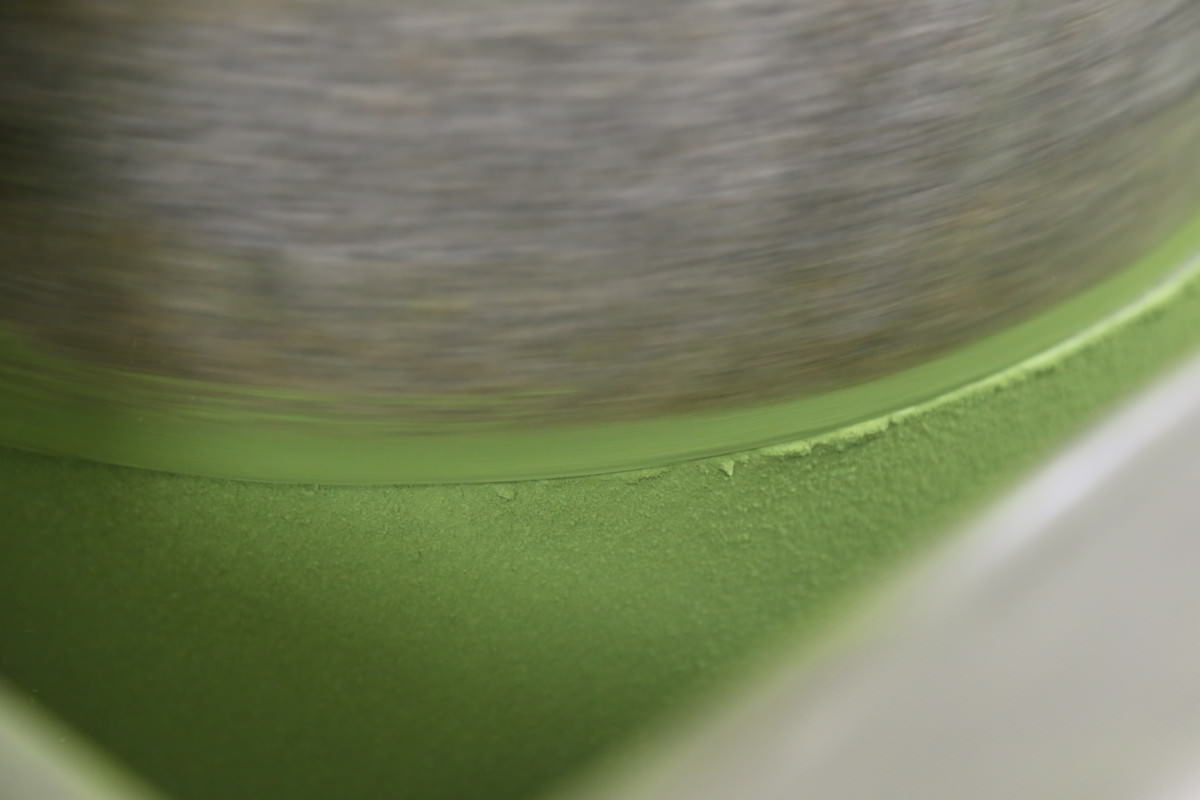
Authentic Japanese matcha has been ground in stone mills for centuries. Our stone mills are made of granite because it is particularly durable and does not overheat as quickly. This is a crucial factor in the quality of the matcha.
8. UMAMI
A distinctive feature of ceremonial premium-grade tea is the umami flavor. The Japanese researcher Ikeda Kikunae was the first to describe the umami flavor in 1908. Ikeda discovered that, in addition to the basic tastes of sweet, sour, salty, and bitter, the sense of taste perceives yet another quality. If you’re curious about what umami tastes like, simply use a slightly higher dose of our Super Premium Tenno (starting at about 3 grams or more). But don’t forget to use water that’s below 80°C so the matcha doesn’t become bitter. When you prepare the matcha this way, you’ll get a particularly sweet and creamy result with plenty of umami.
9. THE INGREDIENTS
Matcha is hailed as a superfood in the media because of its nutritional content. This is due in part to its catechins, and in particular to the epigallocatechin gallate (EGCG) it contains. Researchers are currently conducting numerous studies to investigate its effects. There is already evidence suggesting that EGCG could help with many diseases. You can find more information on this, for example, in thisarticle.
Night owls and morning grouches will be happy to know that matcha contains caffeine. And that’s not all! Unlike coffee, the caffeine in matcha lasts significantly longer due to its delayed absorption. This is due to the tannins, to which the caffeine is bound and which the body only absorbs during digestion. This way, you’ll enjoy the effects for a long time.
L-theanine, an amino acid found exclusively in tea, adds a calming quality to the caffeine boost. That’s why, despite the caffeine it contains, you won’t feel restless or jittery after drinking matcha (as you might after a strong cup of coffee).
10. THE PRICE
We’ve all been there: you walk into a store and see an item that’s super cheap. You just can’t pass up a bargain like that! Then, once you get home, you realize that the bargain, unfortunately, doesn’t live up to your expectations. The same goes for matcha. The labor-intensive production process automatically results in a higher retail price. In this case, the price can serve as an indicator of quality. If you come across very inexpensive matcha, you should check—just to be safe—whether it’s truly authentic Japanese matcha or simply ground tea. After all, “matcha” is not a protected term. In theory and in practice, any ground tea can be labeled and sold as matcha. So, keep your eyes open when buying matcha!


Leave a comment (all fields required)